The evolution and development of our product

Front Covers from original packaging (start-finish) to final product (L-R)
Back covers from start to finish (L-R)

These images are a representation of the key stages of the changes and development that was applied to our redesign from original box to the final box. Overall, we had 3 main prototypes that were user-tested and shown in class (the middle boxes). However, throughout the various user testing stages we would also test certain aspects or sections of the informational layout/design.

The greatest developmental changes included changing the format of the ‘where to test’ information into two timelines/scenarios. This was because many of our users found the info difficult to interpret and understand. By creating a visual timeline and graph, people could dissect and categorise the scenarios for possible and most effective testing times easier.

The sharper sectioning of the different stages of using the rules have also helped to focus the eye on information relevant to that stage only. This has been aided by the fact that we have tried to be as concise as possible, the information on the box catering for the immediate actions the user would take at the time of the testing. By only including info that was most relevant to those stages, we were able to cut out a lot of repeating info and jargon that could be located in the leaflet inside the box. Through our user testing, we found that most people wouldn’t refer to the leaflet, unless they found a need for more detail that wasn’t located on the box.

Interestingly, we found the most positive feedback in reverting to our original colours, and using a red accent only sparingly on iconography or text that couldn’t be overlooked. Keeping the red minimal drew the eye and meant more for the user than if it was used more consistently and evenly along with our other colours.

User Tests on Visual Timeline

Visual Timeline Iteration 1
Viusal Timeline Iteration 2
Liam and Yoshi user tests notes

Our information re: When to test has come a long way from our first prototype. After feedback from user testing, we decided to display the info in a timeline as this was easier to dissect and understand.

Yoshi User Test: Male, 27, German

Never looked at a pregnancy test before, issue with language barrier

  • The main takeaway with testing these timelines on Yoshi was that because English is not his first language, his ability to interpret and understand the timelines would provide us with valuable feedback.
  • “You have sex and after 2 weeks you can test”. First timeline was straightforward
  • Unsure about the second panel and what was meant by the “missed period” as well as having disregarded the increasing gradient. The language barrier affected Yoshi’s understanding of this timeline as there were more words to create connections with.
  • However, when asked and provoked, made a more accurate interpretation of the timeline

Liam User Test: Male, 20

  • Was confused about the arrows pointing in both directions, only need them for the direction going forward
  • Also change the sperm movement so it aligns with the direction of the arrow – a subtle visual cue that can help immensely
  • Interpreted both of the timelines accurately.
  • Re: the Increasing gradient: said unprompted, “The line’s going up show it increases accuracy the longer you wait”.

User Tests on 3rd Prototype

David Sless: key takeaways

  • Crucial to do as many user tests as possible on a variety of people – an optimum of 6
  • If we want to use images, important to accompany with text as imagery/iconography cannot always be understood by themselves
  • In leaflet, be more specific as to what we mean by ‘cautions’. Use headings that are less vague
  • Currently have an inconsistent ‘voice’ for the double double weighting. Need to be wise and consistent about what parts of the text we choose to emphasise/bold
  • ‘Potential for Error’ is broad and wordy, break down this heading into something more digestible and specific
  • Words ‘potential’ and ‘medical’ are not useful and slightly redundant. Everything to do with our packaging is medical…
  • The overview displayed on the front cover of leaflet looks too similar to and advertising scheme. Either take out of the box or create more hierarchy within the box with headings/key words
  • Re-work hierarchy. 99% Accurate before info on sensitivity levels.

Klaus User Test: key takeaways

  • Thicken the stroke of the pregnancy test diagram on the side of the box. Don’t be afraid to make it as obvious as we can, as the current line drawing is too faint and could be overlooked
  • Reduce the size of the ‘Pharmacy Only’ text on the lid of the box so it is smaller, and include the branding and logo. Contextually, the ‘Clarity’ branding would be lost if the box was only visible from a birds eye view, and including the brand on the lid will help identify the product
  • Switch the top flap so it is connected to the back of the box and opens from the back rather than the front
  • Change the wording of ‘can test early’ to ‘early testing possible’ from timeline as confusing.
  • If the importance of ‘not touching the membrane’ on the pouch must be emphasised, then explore more direct ways to do this. Currently not obvious enough. This could mean… the membrane of the diagram is highlighted; include iconography beside the label of ‘do not touch’ so more obvious; cutting a hole for where the membrane is and using transparent paper to directly show user
  • Explore perforation of the seal of pouch, so it reveals and provides a secondary reminder for the user to ‘use within 1 hour of opening’ rather than just having the warning printed – two layers, removes part of the seal to reveal the warning
  • Overall a huge improvement from the second prototype as it is more spacious, cut back from a lot of extra information that could be referred to inside the booklet, and ‘when to test’ information easier to understand with the timeline.

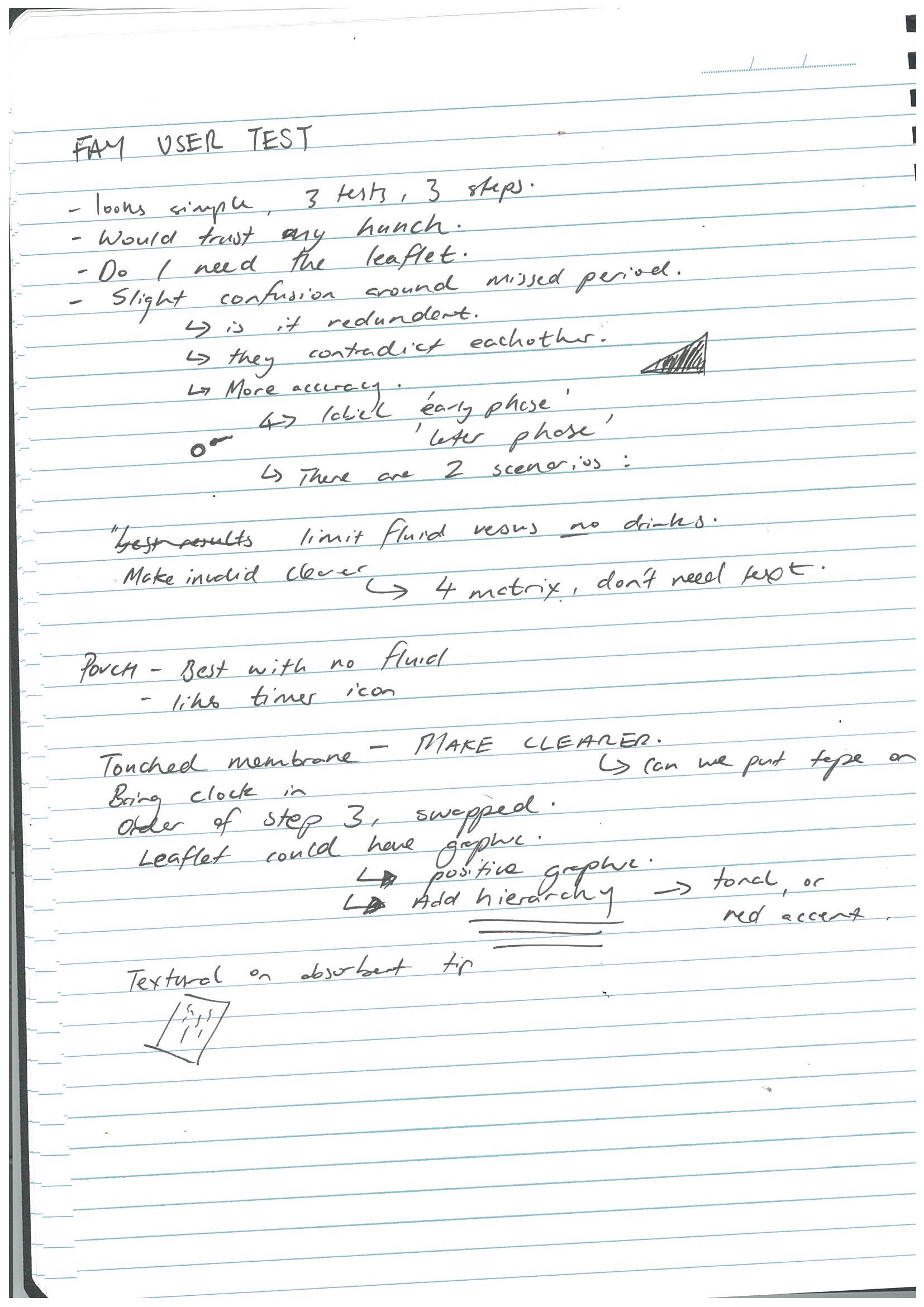
Fay User Test: key takeaways

Has used a pregnancy test before.

Scenario: Is wanting to get pregnant, had sex recently 16 days ago and needs to know if the product is right for her.

  • Simple and clean use of typography, 3 tests and 3 steps seem easy to use
  • Trusts intuition – probably fuelled by the fact that she has used one before
  • Personally, doesn’t find the leaflet super necessary, however depends on what sort of person you are. Some might want to be super cautious and read every detail
  • Slight confusion around the ‘missed period’ milestone and what it means to take the test around that time, is it redundant if the test falls in the other ‘sex/fertilisation’ timeline as well as within the 2 weeks mark?
  • Do we need to put a heading above each timeline e.g. Early Phase vs Later Phase, to create an obvious difference between the two scenarios
  • The cautionary ‘limit fluid’ could be stated as ‘no drinks’ instead to be clearer.
  • For the invalid diagram in ‘invalid’ split into 2 so all scenarios are depicted as a matrix and are consistent in size. Can remove the text.
  • Fay also touched the membrane, so we have to make that warning more obvious. Reiterate the need to put the type ‘C’ and ‘T’ around the result window on the product, as well as a clear tape to cover the membrane.
  • Re: Instructions on the box, introduce a visual aid for the timing, such as a clock to provide another point of interest
  • Swap the order of phrasing in Instruction 3
  • Include more graphic iconography in the leaflet
  • Include more hierarchy in the leaflet such as red accents
  • Put texture on the absorbent tip diagrams to distinguish from the rest of the line drawing, by being subtle but also replicating the actual product. Having the dark shade on the absorbent tip is too confusing as it throws users off.
  • EMPHASIS on the positive interpretation in the leaflet, as this is the diagram that will ultimately alter the user either in an expected or unexpected manner. Either put red accent or highlight the heading for it.
  • Spot colour has been used wisely and not overdone. Keep this up.

Hannah User Test: key takeaways

Has used a pregnancy test before.

Scenario: Only had sex a couple of days ago and needs to know if she is eligible for the pregnancy tests, knowing that her period is a while away.

  • Responded well to the timeline which was the aim of the first scenario. Decided not to test based on the info provided as her situation would have been too early.
  • Re: Overview, include info on testing early as well?

Scenario: Is eligible to test, how to go about using the pregnancy test and following instructions?

  • Was a little confused and more cautious having seen the instructions on 3 different touch points of the product – box, leaflet and pouch. Is the type of person who would read everything.
  • Re: the pouch, read but overlooked the warning to not touch the membrane. Touched the membrane anyway, showing that this is a product fault and not us.
  • Having done a pregnancy test before, user relies a lot on prior knowledge.
  • Confused by the ‘can test early’ label on the timeline, would be more understandable if ‘testing effective’
  • Information was easily accessible on box and leaflet

Prototype 3 (leaflet and pouch)


Leaflet

The changes we made to our leaflet included reverting back to the purple colour scheme, incorporated the timeline in place of the text for test preparation, and also extra iconography and refinement of the diagrams.

We also went back to the initial concept with the leaflet cover page, to align it with the new style and keep it peeled back.

Pouch

We hadn’t yet redesigned the pouch that held the test stick, and realised that it was a crucial touch point for the user’s user journey. Not only was the pouch important in reiterating some of the information such as the instructions that was already found on the box, but providing immediate cues that made more sense to be on the pouch than the box. This included the cautionary ‘Use within 1 hour of opening seal’ at the seal of the pouch, that would serve as an important reminder just as the user intended to use the device. The expiry date and the diagram of the test stick with the label showing where the membrane should be avoided was also a vital caution.

We wanted to keep the pouch as straightforward as possible in terms of information i.e. this is the stick and what to expect, and here is another run down of the instructions and interpretations as the chances of the user not having the box with them while they used the product was relatively likely.

To keep with the style of our packaging and ensure it still held a clean and elegant flavour, we followed through with the white stripe on one side of the pouch, but also for the interpretations section on the back as an effective way to distinguish and seperate info.

Prototype 3

Changes from prototype 2

After reviewing and discussing the feedback we received from our user tests and Klaus, we realised there was still a lot to improve on. The fact that our packaging had taken an alternative style didn’t make the information easier to understand. It was crucial that we were more ruthless with our decisions, and removed information that didn’t need to be on the outside of the box if it could be stated on the leaflet, as well as paraphrasing the copy so it got straight to the point and gave the user the most immediate advice, notes and actions. Displaying the information ‘when to test’ through a diagram/timeline would also be a crucial development.

Cover

Klaus made a good point about not having to see the device and product, especially if already had a diagram of it on the side of the box. What if there was a way we could still convey the use and message of our product, without explicitly saying it? We removed the diagram of the pregnancy test, to a subtle and simplistic form of the uterus, putting emphasis on the ovaries as that is where all the magic essentially happens, but in a nuanced way.

Colour

We also reverted back to the purple colour and removed the gradient, as we received lots of positive feedback where most of our user testers preferred the soothing, gender neutral, yet clean and medical connotations of purple.

Side Panel

The overview and cautions panel still contained too much information, and needed to be reduced so it wasn’t information overload. It was important the packaging had enough breathing room, which would not only benefit the design and layout, but also how the users approached it copy they needed to know most. By being strict on only showing the most important facts and cautions the user is not bombarded with text and are advised to look up further information inside the leaflet on the box if they choose to do so.

Even though the little drops and cross icons provided a point of difference and interest in our second prototype, we decided to utilise the ‘plus’ symbols instead as we used them on our cover and it would be better to keep the consistency across the box. It also aligned with being a ‘medical product’ more effectively.

Timeline

Our most important change from the second prototype was incorporated a timeline to display the ‘when to test’ information. This was because the majority of our user tests struggled to understand the meaning on the information and was still confused on when they should best test. By dissecting the info and laying it out visually, we would hope this would enable the users to understand it more successfully. The information discusses 2 different approaches to testing – after sex/fertilisation and also around the missed period. Without the timeline, this information always felt contradictory. We noticed that it was going to be crucial to portray these 2 different approaches on seperate timelines as it emphasised a different user journey.

Reduce and Emphasise

Just like the side panel, we had to be ruthless and straight to the point with the body copy. We took out unnecessary words that didn’t actually need be there which in turn, made the instructions and interpretations less overwhelming for the user and also didn’t overbear the diagrams but complemented them instead. This also created more space so the text and diagrams weren’t squished in.

Prototype 1

This is our first packaging prototype. We tried to limit the creative direction so were mainly focusing on how the layout was positioned. After the card sorting activity, a lot of the information had to be distilled and paraphrased. The box is an example of further distillation of the information so it could fit on the small real estate.

We spent a lot of time figuring out what we thought was the most important information, and struggled with deciding how much of the overview/scientific information about contextual settings (when, where, why and how pregnancy occurs) was suited. In the end, we thought that it would be better to put what we thought was summarised context and see how our peers reacted to the information. With the feedback we could then go from there and perhaps cut back on certain facts and figures.

Overall, we are happy with our first prototype. It feels clean and a lot clearer than the initial product we are reformatting. The one colour palette and diagram imagery adds a field of legitimacy but not so clinical that it wasn’t offputing.

Prototype 1 (leaflet)

This is the accompanying leaflet that was redesigned alongside the box. An important factor that fed into the redesign was to cut out duplication of information (which we found to be true of the previous product) and to space the info so it followed what we considered as an a credible user path. By categorising the info under certain sections, this would mean the user didn’t have to search too long for what they were looking for, and could head straight to the section required.

User path on leaflet: title/overview –> test preparation –> cautions –> test steps –> interpretation –> potential for error –> cross reactivity

A lot of thought was placed into the physical handling of the leaflet and how best the sequential placement of information could benefit the user’s journey when using the product. We tested with different paper folding techniques such as an accordion fold, a Z fold, a parallel fold and eventually decided to use a single open gate fold, so the user had the experience of opening the leaflet in a more engaging manner but also so the information inside such as the instructions and steps could be grouped visually together.